
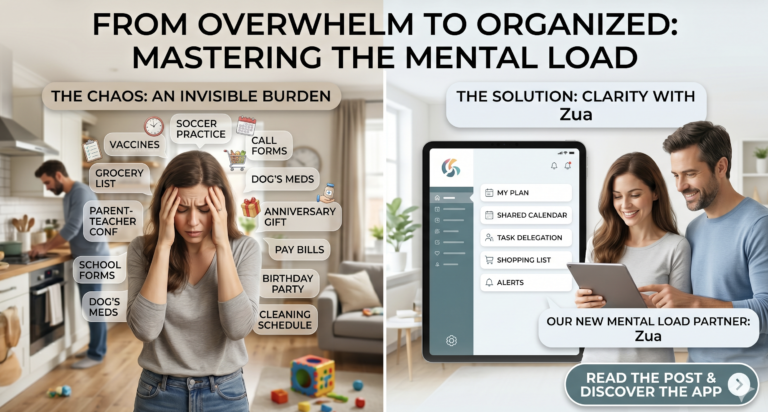
If you’ve ever lain awake at 1am mentally running through tomorrow’s school drop-off, the dentist appointment you forgot to rebook, the permission slip on the kitchen counter, and whether there’s enough food in the fridge for dinner — you already know what mental load is. So, how to Reduce Mental Load as a Parent?
What Is Mental Load?
Mental load (sometimes called “cognitive labor” or “the invisible workload”) is the constant, invisible work of managing a household — not just doing tasks, but remembering they exist in the first place, planning them, delegating them, and following up to make sure they actually happen.
It’s the difference between “taking out the bins” and “knowing the bins need to go out, that Tuesday is collection day, that the recycling hasn’t been sorted yet, and that someone needs to remind the kids to bring their PE kit back in before it rains.”
Research consistently shows that this invisible labor falls disproportionately on mothers — but it’s increasingly recognized as a burden that affects all parents, regardless of how household responsibilities are divided. And it’s exhausting.
Why Mental Load Builds Up in Modern Families
Modern family life is more complex than ever. Between school schedules, extracurricular activities, childcare arrangements, work demands, meal planning, healthcare appointments, and the endless logistics of running a household, the number of open “tabs” running in a parent’s mind at any given time is staggering.
Here’s the thing: it’s not that parents aren’t organized. It’s that the system of family management is broken. Information lives in multiple places — a shared Google Calendar here, a WhatsApp group there, sticky notes on the fridge, mental notes that never quite make it anywhere. The result is a constant low-level hum of anxiety that never fully switches off.
5 Practical Ways to Reduce Mental Load
1. Name the invisible work
You can’t share what hasn’t been acknowledged. The first step is making the invisible visible — actually listing out every recurring task, decision, and coordination responsibility in your household. This includes things like:
- Tracking when kids need new shoes
- Knowing which friend’s birthday is coming up
- Managing school communications
- Scheduling GP appointments
- Keeping on top of household supplies
Once you can see the full picture, it becomes much easier to have an honest conversation about how to distribute it.
2. Stop relying on one person’s brain as the family database
If all the family’s information — schedules, medical history, school contacts, activity dates — lives primarily in one parent’s head, that parent becomes a single point of failure. And a deeply stressed one.
The fix is to externalize that information into a shared system that everyone in the family can access and contribute to. This reduces the emotional weight of being the sole keeper of family knowledge.
3. Batch decisions, don’t make them on the fly
Decision fatigue is real. When every evening involves fresh micro-decisions — what’s for dinner, who’s doing bath time, what time does the school run need to happen — it drains mental energy fast.
Try batching recurring decisions: plan meals weekly, set a standing schedule for chores, agree in advance on who handles school communications. The goal is to convert repeated decisions into automatic systems, freeing mental bandwidth for the things that actually need your full attention.
4. Delegate meaningfully — including to your kids
Children are capable of more than parents often give them credit for. Age-appropriate chores and responsibilities don’t just reduce parental load — they build independence and confidence in kids. A 7-year-old can be in charge of setting the table every night. A 10-year-old can manage their own school bag.
The key is genuine delegation: not just assigning a task, but transferring the responsibility for remembering and doing it. That’s the part parents often skip, which means they end up doing the mental work of tracking whether the delegated task was actually done.
5. Use tools designed for family management
There’s no shame in getting help. Just as businesses use project management software to coordinate teams, families can use purpose-built tools to coordinate household life.
The best family organization tools don’t just store information — they help distribute the cognitive work of managing it.
How Zua Helps Reduce Family Mental Load
This is exactly the problem Zua was built to solve.
Zua is an AI assistant designed specifically for busy families. Rather than replacing your judgment as a parent, Zua acts as a second brain for your household — remembering things so you don’t have to, prompting the right people at the right times, and helping your whole family work as a team rather than relying on one overwhelmed person.
Here’s how Zua makes a real difference:
Centralized family scheduling. All appointments, activities, and commitments live in one shared space that every family member can see. No more “I didn’t know about that” moments.
Smart task and chore management. Assign tasks to kids and partners, set reminders, and track completion — without nagging. Zua handles the follow-up so you don’t have to hold it all in your head.
Childcare coordination. Managing pickups, childminders, after-school clubs, and playdates is one of the most logistically complex parts of modern parenting. Zua keeps it all organized.
Proactive prompting. Zua doesn’t wait for you to remember — it surfaces what needs your attention before it becomes urgent. Think of it as a thoughtful assistant who’s always one step ahead.
Reduced cognitive overhead. By externalizing the planning, reminding, and coordination work, Zua frees you up to be more present — as a parent, a partner, and a person.
The Real Cost of Ignoring Mental Load
Mental overload doesn’t just cause stress. Over time, it contributes to burnout, relationship strain, and a chronic feeling of never quite being on top of things — even when you’re working incredibly hard.
Parents who carry disproportionate mental load often report feeling invisible in their effort. The work they do is constant, but because it’s cognitive rather than physical, it’s easy for others (and sometimes themselves) to underestimate.
Addressing it isn’t about finding a perfect system or becoming more productive. It’s about building a family environment where the work of managing home and children is genuinely shared — and where no one person is carrying the weight of the whole household in their head.
A Lighter Load Is Possible
Reducing mental load takes honesty, communication, and — yes — the right tools. It’s not about doing less, it’s about carrying less alone.
If you’re ready to stop being the family’s unpaid project manager and start actually enjoying your time together, Zua is here to help.
Try Zua free and experience what it feels like when your family runs itself.