
A Personal AI Assistant is easy to get started with today. You can ask ChatGPT or Gemini to draft a grocery list, summarize a school email, or suggest dinner ideas in seconds. But for most families, the real challenge is not isolated productivity — it’s coordination. That’s why many parents eventually discover they need a family AI assistant more than a personal one: something that sees the whole household, understands competing schedules, and turns chaos into shared family planning.
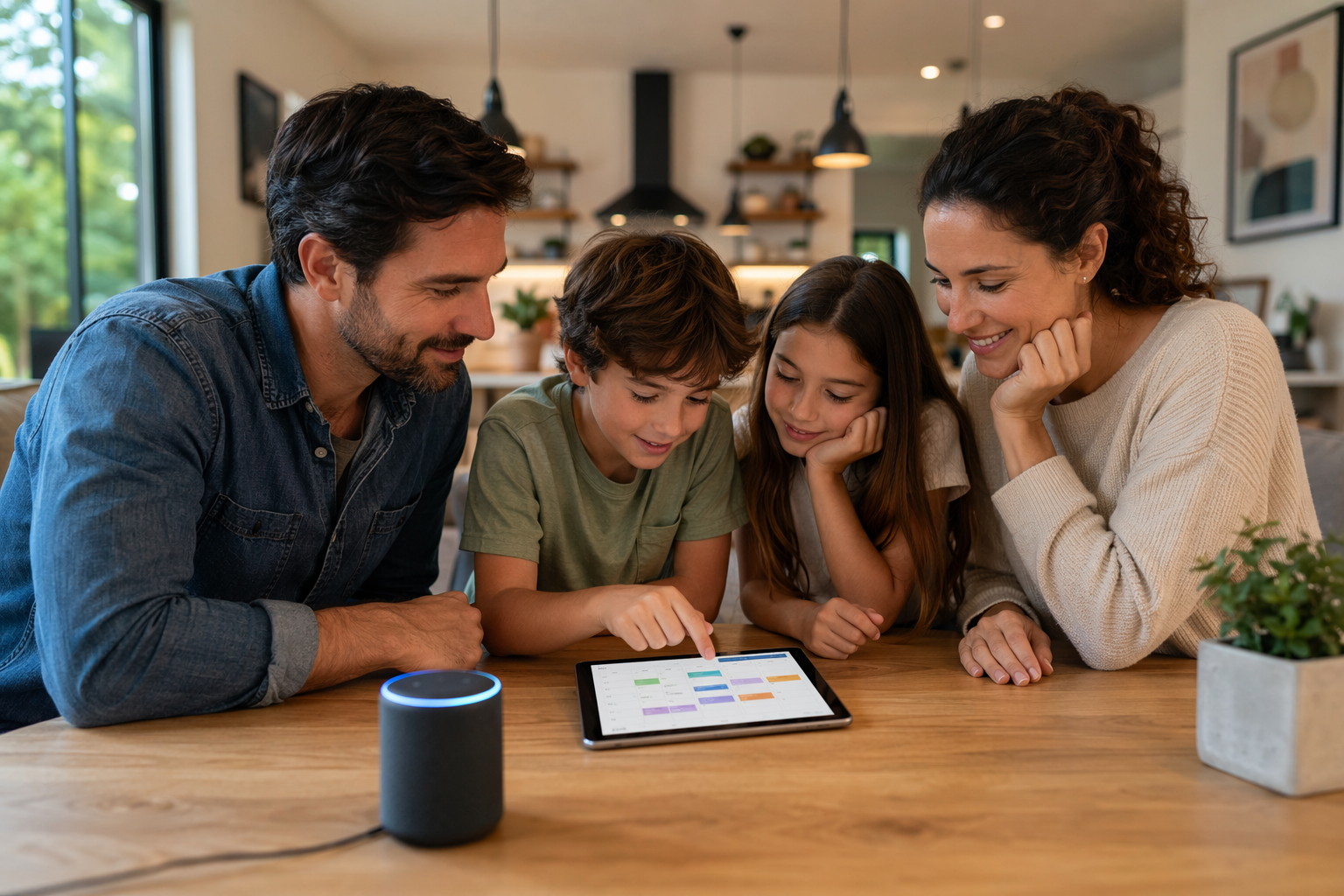
If your life involves school pickups, work meetings, baby naps, sports practice, grandparents, babysitters, and the occasional emergency dentist visit, a solo assistant model breaks down quickly. The issue is not intelligence. The issue is context. A genuinely useful family system needs Google Calendar integration, smart scheduling, visibility controls, and a way to interpret the full family workload — not just one person’s to-do list.
Personal AI Assistant: Great for Individuals, Limited for Families
A Personal AI Assistant shines when the task is simple and self-contained. Need a response drafted? A plan brainstormed? A reminder created? Easy. Need to manage a family of four with overlapping calendars, school comms, work obligations, and shifting responsibilities? That’s where the cracks appear.
Free tools like ChatGPT and Gemini can absolutely help one person be more organized. In fact, they’re excellent for generating checklists, rewriting emails, and reminding you what to buy. But families don’t live in a single stream of prompts. Family life is a network of dependencies:
- If one parent is in a meeting, the other may need to handle pickup.
- If school changes a schedule, both parents need to know immediately.
- If a grandparent or babysitter helps occasionally, they need partial visibility — not access to everything.
- If a child’s activity is added, it affects transport, dinner timing, and evening routines.
That’s why a personal assistant alone often ends up being a “nice extra” rather than a system that actually reduces friction.
Why a Personal AI Assistant Isn’t Enough for Modern Family Life
Families are a coordination problem, not just a productivity problem. The average working parent is dealing with multiple calendars, multiple devices, multiple communication channels, and multiple people with different levels of access. A personal assistant can help you think faster. A family AI assistant helps everyone move faster together.
Consider the scale of modern digital overload. Microsoft’s Work Trend Index has repeatedly shown that digital work fragmentation and message overload are major sources of stress for knowledge workers, especially when people are juggling communication across apps and schedules. See Microsoft’s research hub here: Microsoft Work Trend Index.
Now add children, school communications, and shared caregiving. A parent isn’t just managing tasks; they’re managing dependencies, timing, and emotional load. This is why “just ask AI” often fails in practice. The assistant may be smart, but it doesn’t know:
- who is actually free to help;
- which events are private versus family-wide;
- what’s already in Google Calendar;
- which items are urgent and which are just context;
- how one change affects the rest of the week.
Families need a system that sees the whole picture — not just the message in front of it.
Personal AI Assistant vs Family AI Assistant: The Real Difference
The best way to compare them is by function, not hype. A Personal AI Assistant is optimized for one user’s output. A family AI assistant is optimized for household coordination, visibility, and smart scheduling across multiple people.
| Capability | Personal AI Assistant | Family AI Assistant |
|---|---|---|
| Primary user | One person | Entire household |
| Calendar view | Individual tasks and events | Unified family calendar with a “big picture” view |
| Scheduling | Suggests ideas based on prompts | Detects conflicts and proposes the best slot automatically |
| Integration | Can summarize information manually | Reads from Google Calendar and other device calendars |
| Privacy | Usually one account, one context | Granular sharing with family members, grandparents, nannies, babysitters |
| Task management | General to-do list | Family-aware chores, heads-ups, and time-sensitive actions |
This difference matters because family life is not just a list of tasks. It is a shifting system of responsibilities. A family AI assistant should reduce the “mental math” of who needs to be where, who’s available, and what happens next.
How Smart Scheduling Actually Reduces Family Stress
Smart scheduling is not about filling every empty slot. It’s about protecting the right people from the wrong commitments at the wrong time. In families, that means fewer double-bookings, fewer missed handoffs, and fewer last-minute arguments about who forgot what.
A strong scheduling system should:
- Read existing commitments from Google Calendar and work calendars.
- Detect conflicts before they become a problem.
- Suggest alternatives based on real availability.
- Assign tasks intelligently when one parent is busy and the other is free.
- Support shared family planning without making every detail visible to everyone.
That last point is critical. Shared family planning fails when it becomes either too opaque or too exposed. People need enough visibility to coordinate, but not so much that privacy disappears.
For example, a school pickup should probably be visible to the relevant parent or caregiver. A work meeting may only need to be visible as “busy.” A doctor’s appointment might need to stay private. This is where a family AI assistant becomes more useful than a general-purpose Personal AI Assistant: it handles the social layer of scheduling.
Why Google Calendar Integration Matters More Than a Fancy Chatbot
Most families already use calendar systems in some form, especially Google Calendar. That’s good news: the smartest AI assistant is often not the one that replaces your existing setup, but the one that connects to it.
With proper Google Calendar integration, an AI can:
- see existing events before suggesting new ones;
- avoid duplicate appointments;
- suggest a time when both parents are available;
- surface school events, work meetings, and extracurriculars in one place;
- keep personal and family events separate while still coordinated.
Google’s own calendar ecosystem is designed for broad interoperability and shared access. You can review the product and sync options here: Google Calendar.
The key insight: AI is far more useful when it works with the data you already trust. A good Personal AI Assistant can help you think. A good family AI assistant can help your whole household act.
What a Family AI Assistant Should Do That a Personal AI Assistant Usually Doesn’t
When evaluating tools, look for family-specific features that solve real household pain points. For example, Zua — AI Family Assistant is built around the idea that a family needs a shared operating system, not just a smart prompt box.
Useful family-first capabilities include:
- Unified calendar visibility so you can see the “big picture” of everyone’s day.
- Conflict detection to flag overlapping commitments.
- AI auto-scheduling that proposes better times based on availability and preferences.
- Granular privacy controls so you can share only what each person needs to see.
- Extended family support for grandparents, nannies, babysitters, and other helpers.
That last feature matters more than people expect. The modern family often depends on a “support network” beyond the immediate household. A family AI assistant should make that network easier to coordinate, not harder.
The Family Brain: Turn Random Messages into Action
One of the biggest problems in family life is not planning, but capture. School newsletters, screenshots from another parent, forwarded emails, voice notes, and last-minute texts all contain important information — but only if someone manually converts them into tasks and calendar entries.
This is where a family AI assistant becomes dramatically more useful than a Personal AI Assistant. Instead of making you copy-paste details all day, it should act like a “family brain” that recognizes context and converts it into action.
For example, a strong family assistant should let you:
- forward a school email and extract the event date automatically;
- share a screenshot of a birthday invite and create a reminder;
- send a WhatsApp voice note to add a shopping item or appointment;
- use your phone’s native share sheet to capture PDFs, web pages, and messages instantly.
Zua supports exactly this kind of workflow: it helps families stop being “data entry clerks” and start being coordinated. If you want to explore the feature set, see Zua’s features page or try Zua free.
How to Set Up Smarter Family Scheduling in 5 Steps
If you already use a Personal AI Assistant, you don’t need to throw it away. Instead, layer it into a family system that makes your whole household easier to manage.
- Connect your calendars. Bring in Google Calendar and any work calendars you use regularly.
- Create a shared family view. Separate personal, shared, and private events so visibility is intentional.
- Define household roles. Decide who handles pickups, school admin, medical appointments, and backups.
- Set smart rules. For example, if one parent has a meeting, the assistant should suggest the other parent for the task.
- Capture everything in one place. Use WhatsApp, email forwarding, screenshots, or voice notes so details don’t get lost.
Once these steps are in place, your Personal AI Assistant becomes more effective too — because it’s no longer working in isolation. It can operate inside a shared system with better context.
Who Benefits Most from a Family AI Assistant?
Families with babies, kids, dual working parents, shared custody arrangements, or heavy extracurricular schedules will usually feel the biggest difference. But the value is not limited to “busy” households. Any family with multiple schedules and responsibilities can benefit.
That includes:
- parents managing school and nursery timetables;
- families coordinating with grandparents or caregivers;
- households balancing shift work and childcare;
- families with complex recurring activities like sports, music, therapy, or tutoring.
The more moving parts you have, the more a family AI assistant pays for itself in time saved, stress reduced, and fewer missed commitments.
Conclusion: Use a Personal AI Assistant, But Build Around the Family
A Personal AI Assistant is a great starting point. It can help you think, draft, summarize, and organize. But if you’re a parent or caregiver, your real pain point is usually household coordination. That’s why a family AI assistant is often the smarter investment: it handles shared family planning, integrates with Google Calendar, detects conflicts, and keeps everyone aligned without turning your life into a second job.
In other words, don’t just ask, “How can AI help me personally?” Ask, “How can AI help my family function as one coordinated system?” That shift is where the real value appears.
If you’re ready to move beyond isolated productivity and into true family coordination, try Zua free.
Frequently Asked Questions
What is a Personal AI Assistant?
A Personal AI Assistant is a tool that helps an individual write, plan, summarize, and organize tasks using AI. It’s useful for productivity, but it usually focuses on one person’s needs rather than the whole household.
Why do families need a family AI assistant instead of just a personal one?
Families deal with shared schedules, childcare handoffs, school communications, and multiple calendars. A family AI assistant provides a unified view, smart scheduling, and shared family planning that a Personal AI Assistant usually cannot handle well on its own.
How does Google Calendar integration help family organization?
Google Calendar integration lets an AI assistant read existing events, detect conflicts, and suggest better times based on actual availability. It also helps keep personal and family commitments aligned without manual copying and pasting.
Can a Personal AI Assistant still be useful if I use a family AI assistant?
Yes. A Personal AI Assistant can still help with writing, research, and one-off planning. The best setup is often both: use a personal assistant for individual productivity and a family AI assistant for household coordination.